We all have those people in our lives—the ones who always know which buttons to press. Whether it’s a moody coworker, a judgmental family member, or a friend who always throws subtle jabs, dealing with difficult people can leave you feeling emotionally drained. It often feels like no matter what you say or do, it’s never quite right.
The good news? You can learn how to stay calm around difficult people by building emotional awareness, setting healthy boundaries, and shifting the way you respond. In this guide, you’ll find relatable examples, practical ideas you can apply immediately, and strategies that actually work when things get tense—even if someone is trying to get under your skin on purpose.
Why Difficult People Get to YouBefore learning how to respond, it’s important to understand why certain people affect you so much. Difficult people often trigger stress because they make communication feel unsafe. You’re constantly guessing how they’ll react, which puts your nervous system on high alert.
Humans are hardwired for emotional connection. When someone around you is unpredictable, critical, or passive-aggressive, it creates a sense of emotional friction—even if they’re not openly aggressive.
Let’s look at some everyday examples:
- A colleague sends curt emails with no greeting or thanks.
- A friend makes little digs like, “Must be nice to have all that free time.”
- A family member always plays the victim, even when they’re clearly in the wrong.
- Your neighbor rolls their eyes anytime you mention something positive.
In these situations, it’s not always what they say. It’s how they say it. That’s why these encounters linger in your mind and can ruin your mood for hours.
Fortunately, once you understand this emotional pattern, you can stop reacting and start responding with intention.
Start by Breathing Before ReactingWhen someone says something rude or passive-aggressive, it’s natural to get defensive. Your heart rate goes up, your breath shortens, and your mind starts racing for a comeback. But reacting on impulse rarely helps—and often makes the situation worse.
Instead, create a habit: pause and breathe.
Even taking three deep breaths can help reset your nervous system. You give yourself a mental buffer, allowing the emotional part of your brain to quiet down so your rational thoughts can kick in.
It might sound simple, but studies show that mindfulness techniques like controlled breathing actually reduce cortisol, the stress hormone. Over time, this technique trains your brain to respond instead of react.
Real-life example:
You’re having lunch with a coworker who says, “Wow, three lunches out this week? Must be nice.”
Your first instinct might be to snap back. But instead, you take a breath and say, “I needed a break today—it’s been a long week.”
You stayed calm, owned your choice, and avoided feeding the negativity.
Don’t Take It PersonallyThis one’s easier said than done—but hear me out.
Difficult people are usually acting from their own insecurities, stress, or unhealed trauma. More often than not, their behavior has nothing to do with you. You just happen to be nearby when they choose to unload their emotions in unhealthy ways.
Understanding this doesn’t excuse their behavior—but it helps you take a step back. You stop seeing every snide comment as a personal attack, and instead see it as a signal: “This person is struggling with something they haven’t addressed.”
When you get to that point, you reclaim your power.
If you want a little mental trick, say silently to yourself:
“This is not about me.”
It’s incredibly freeing—and it stops you from mind-reading or overanalyzing.
Set Better BoundariesOne of the most effective tools you can use with difficult people? Boundaries.
Boundaries aren’t about controlling others. They’re about protecting your emotional space. If someone’s behavior consistently drains or frustrates you, it’s okay to set limits on what you’re willing to tolerate.
For example:
- If a friend constantly gossips or makes negative comments, you can say, “I’m not comfortable talking about other people like that.”
- If a coworker dumps extra work on you, you might reply, “I’m focused on my own tasks today, but I can help you later this week.”
- If your partner uses passive-aggressive remarks, let them know: “If something’s bothering you, I’d rather talk about it directly than through hints.”
- These boundaries don’t have to be harsh. In fact, when said calmly and clearly, they often improve communication.
When Someone Is Subtly Trying to Push YouNot everyone is openly rude. Some people use indirect tactics to annoy, manipulate, or provoke you. These behaviors often fall under the category of passive-aggressive communication.
You’ve likely seen this play out:
- “I’m not mad, I just think it’s funny you forgot again.”
- “Sure, I’ll do it—even if it kills me.”
- Or the classic silent treatment.
It’s frustrating because the conflict is never honest or direct.
In these cases, setting boundaries is useful—but sometimes, you just want to know how to disarm them without fueling the fire.
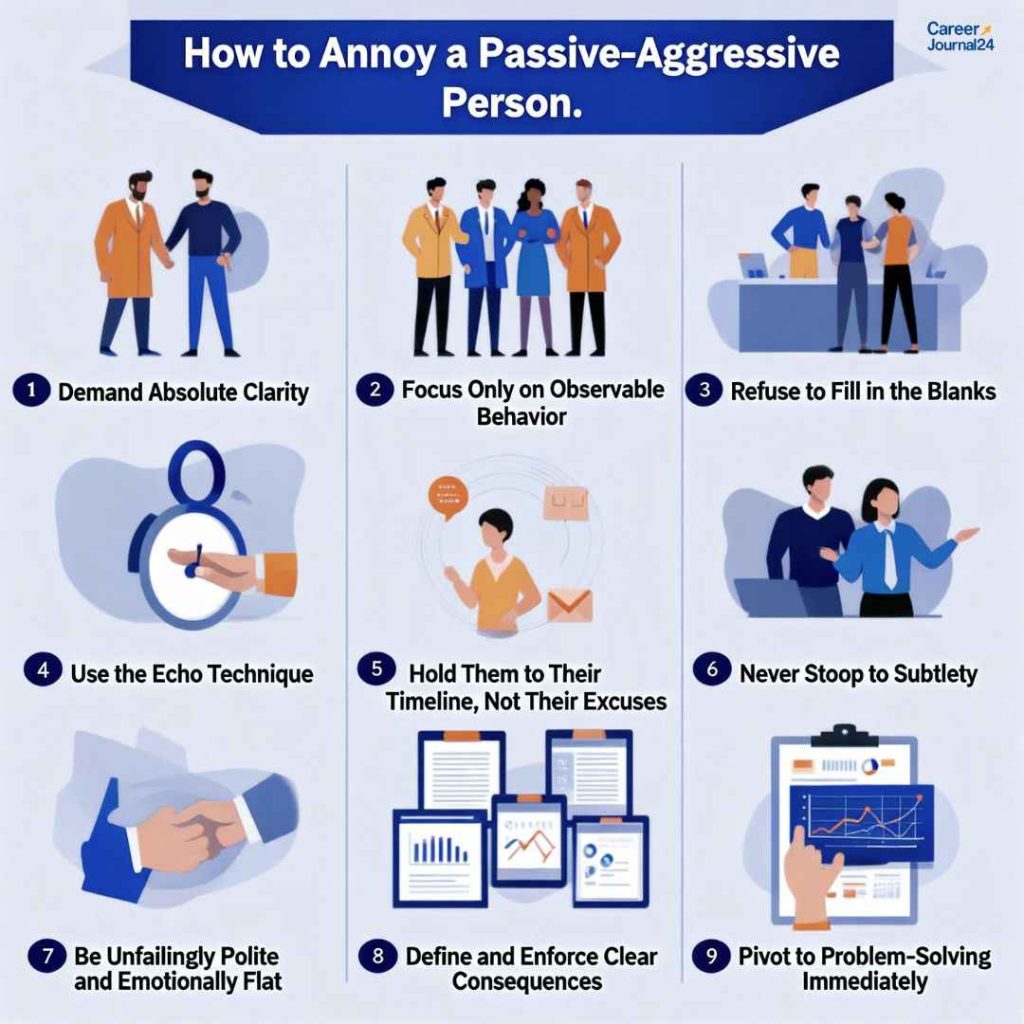
That’s when it helps to learn how to annoy a passive-aggressive person in clever, non-toxic ways. It’s not about being mean. It’s about using subtle shifts in your response to take back control of the conversation and protect your mental energy.
Using kindness, calmness, and even humor are ways to “annoy” without escalating. For example, replying with sincere thanks after a sarcastic comment throws off the whole game—because it breaks the expectation of conflict.
Also Read:
https://careerjournal24.com/how-to-annoy-a-passive-aggressive-person-the-ultimate-tactic-that-works/Use Humor (But Carefully)Humor can be incredibly effective—when used responsibly. It diffuses tension, shows confidence, and turns awkward social moments into manageable interactions.
For instance:
Your roommate says, “Guess I’ll take the trash out again.”
You say, “You’re on a roll! Want to start a cleaning business?”
Said with a smile, this turns criticism into laughter. The key is to keep it light—not cutting or condescending.
Humor isn’t appropriate in every case, especially if the situation is abusive or serious. But in everyday moments, it can be a gentle way to shift energy and bypass negative patterns.
Don’t Argue to WinOne of the best ways to stay calm is to stop trying to win the argument.
Difficult people often thrive on the emotional reactions of others. The more you fight back, the more they escalate. But if you stay calm, don’t match their tone, and disengage when needed, they lose their power.
You don’t always need the last word. You don’t always need to prove your point.
Example:
A customer at work is loudly blaming you for something that isn’t your fault.
Instead of arguing, you say, “Let me check on that for you,” and remove yourself from the immediate tension. You stay calm, and you stay in control.
This doesn’t mean being a pushover—it means being emotionally strategic.
Know When to Walk AwaySometimes, the healthiest thing you can do is distance yourself.
Not every relationship can be fixed. Not every person is willing to meet you halfway. If someone consistently disrespects you, invalidates you, or takes advantage of your emotional energy—you don’t owe them unlimited patience.
Walking away can be physical (stepping out of the room), or emotional (choosing not to engage in gossip or drama). Either way, it sends a message:
“I'm responsible for my well-being, not your approval.”
According to therapist Nedra Glover Tawwab, boundaries aren’t just about what you say no to—they’re about creating space for what matters most.
Build Your Emotional StrengthThe more emotional resilience you develop, the less control difficult people will have over your mood.
Every moment you choose calm over chaos, pause instead of explode, or walk instead of engage—you’re strengthening an inner skill.
Here’s how to build it over time:
- Reflect after difficult encounters. Ask: What worked? What could I try differently?
- Surround yourself with emotionally healthy people (even online communities count!).
- Practice journaling or meditation to process your emotions without bottling them.
- Follow resources on emotional intelligence, such as The Gottman Institute and Psychology Today.
The stronger you grow emotionally, the easier it becomes to recognize when a person’s behavior says more about them than it ever did about you.
Final ThoughtsDifficult people are part of life. It’s unlikely you’ll go a week without encountering someone who’s moody, inappropriate, critical, or passive-aggressive. But that doesn’t mean you have to let them get to you.
You can learn how to stay calm, communicate clearly, protect your energy, and even get a little strategic when needed. Whether it’s setting a boundary with a friend, taking a breath when your manager snaps, or learning how to annoy a passive-aggressive person (in a surprisingly empowering way), you can take back control.
Being calm isn’t about being emotionless. It’s about having enough peace inside that no one can easily take it away from you.
And that’s something to feel good about.